Relationship Empowerment: The Cycle of REACT, REGROUP, REHEARSE, and REDO
The heart of the practice in my Growth and Relationship groups, and applied to life in all contexts, is the cycle of:
REACT REGROUP REHEARSE REDO
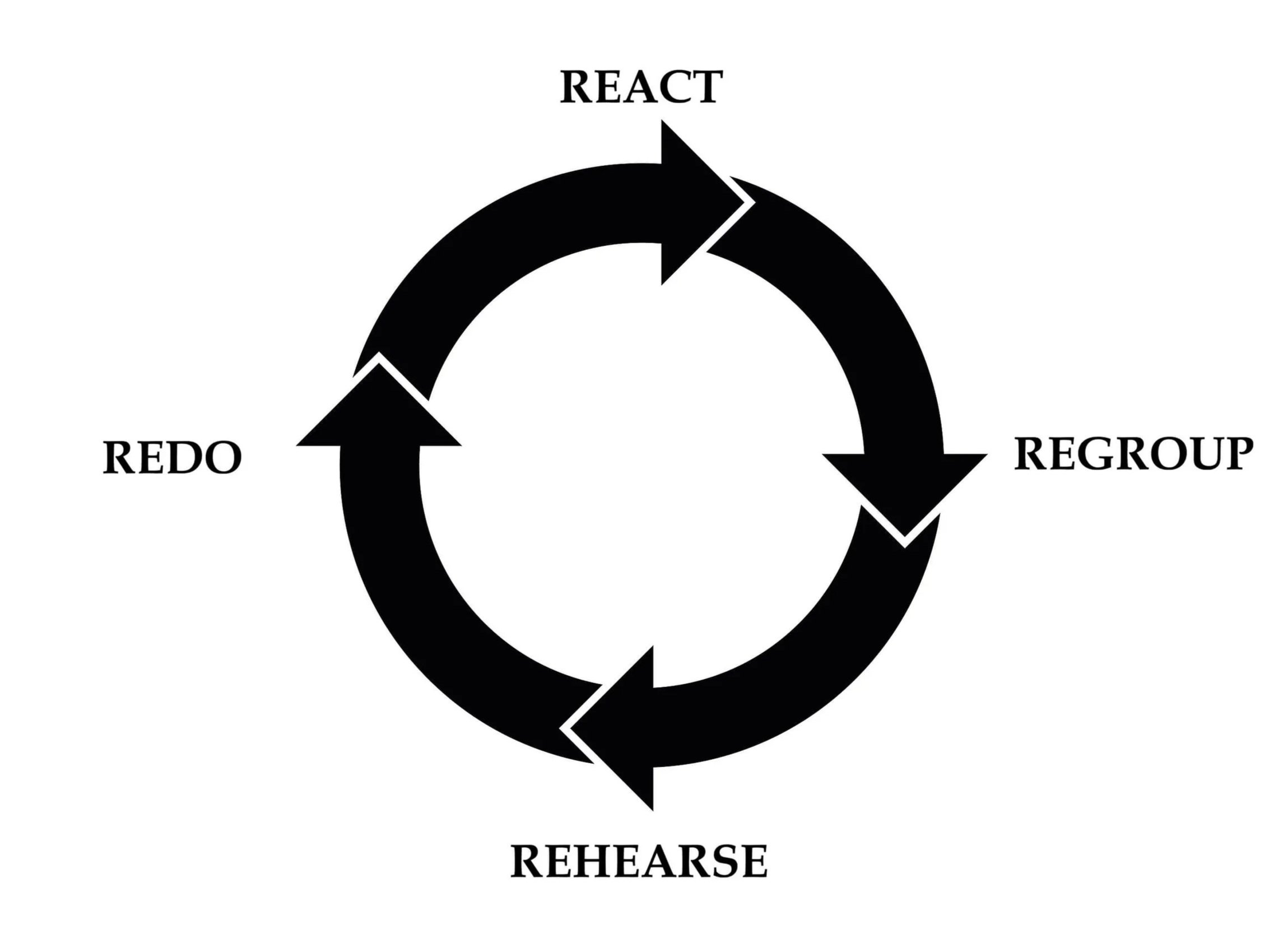
REACT
Placed at the North vantage point is REACT. Life dishes up unending events that trigger us into reactive states. Relationships never cease to deliver us something we do not like. We depend on relationships. They impact us more than any individual part of ourselves. Not possible ever to stop reacting. Hence, we accept as a given that shit happens. At times, more frequently than other times. Our job is to notice the moment.
Another job is to see if we can refrain from problem solving that we or someone else needs to stop reacting. Not part of the human design. Yet easier said than done. We will always want them to stop doing what we don’t like. Our desire is not going away either.
With this frame or perspective, we begin the journey of accepting ourselves and others as Perfect as We Are. Perhaps even more challenging to accept the situation as perfect, the way it is. A paradox. Of course, we want change. Yet we can learn to actively accept and respect the way it is. With the goal of taking charge of our happiness and influencing situations in a way that finds out about the good reasons we all react. Not just from our own vantage point. Respects and welcomes all.
REGROUP
Placed at the East vantage point is REGROUP. Because frustrating events inevitably happen for everyone, we focus on our own power to make a difference. Ourselves. A profound shift in the direction of our energy, resulting in transformational relational empowerment. This runs contrary to our normal human tendency to blame, often whipsawing its target between others and ourselves. We see the truth that life is not fair. We actively turn our attention to our inner world to REGROUP from our REACT moment. Sometimes we need help. We can actively reach out to see if help is available. We make use of our Dependent Self.
With this frame, we are on the journey of building an Independent Self. We can choose to be with ourselves when others are not available. We weave together our Dependent and Independent Selves. We use the self-regulation skill of Claim Compassion Curiosity (CCC) where we Claim what we know without proof, activate Compassion directed towards ourselves, and inhabit Curiosity to explore something we do not yet know. CCC is the central tool of REGROUP.
REHEARSE
Placed at the South vantage point is REHEARSE. We explore options of what to say when we return to the challenging situation. Only after REGROUP can we make use of our Independent Self that can effectively REHEARSE. We tend to bypass REGROUP, seeking to respond to our inner question, “What should I do?” Not wrong. Sometimes REHEARSE is a calming force that helps us REGROUP as we learn about options. Getting ready to take a specific action can provide hope for the future. But at some point, we need to learn how to REGROUP before we REHEARSE. Otherwise, we present an inauthentic and contradictory self in our communications with others.
The essential tool to rehearse is GOAL ACTION SITUATION (GAS). Our human tendency is to identify a goal, often general or vague. Then ask, “What should I do?” We miss observing the SITUATION to gather the relevant details (who, what, where, when). We can pause to gather relevant information about the situation or context. Identify a reasonable GOAL given the situation that supports our ME and our WE. We think about a specific ACTION that supports the goal identified in that situation. We imagine likely consequences for these actions. Sometimes we get support to talk through and try out these actions. More effective to REHEARSE before REDO.

REDO
Placed at the West vantage point is REDO. We return to the challenging situation and experiment with the role of our choosing. We have gained knowledge about repetitive patterns in ourselves, in others, and in the relational systems we are in. We accept them as they are, yet paradoxically seek change, perhaps ever so slightly. From our restored stance in ourselves, armed with rehearsals, we experiment with our voice – what do we say or do? Not with the goal to fix the situation (which is perfect the way it is), but to increase our own satisfaction and develop the relational system.
We initiate the focus of communication in REDO, often in two ways: 1) Repair and 2) Redirect. In Repair, we seek to reconnect with another following a rupture. Perhaps the single most important ability of an intimate partnership. Repair is not the same as Resolve, where we explore ways together to reduce future ruptures. Resolve following repetitive stuck patterns is a worthy goal, but often not achievable until later. In Redirect, we seek to lead the interaction towards a shared activity or task. Rather than talking more about the triggering event.
“R” Words
Notice how many “R” words are used above. Words that capture the experience of repetition. Here are the “R” words above and more that outline the felt sense of the cycle: REACT, Rupture, Remove, REGROUP, Restore, Reclaim, Reprise, REHEARSE, Reengage, REDO, Repair, Reconnect, and Redirect. Know that REACT will come again. To repeat one of the most important lessons from Yvonne Agazarian, creator of Systems Centered Training: “Who we are has more to do with the context than anything about ourselves.”
With our clear goals and tools, we 1) develop our skill to REGROUP where REACT is not as deep, not as often, and doesn’t last as long, and 2) grow more effective with REDO where we see the results of our Effort, Progress, Impact on others, and Claim of our Self-Authority. An EPIC journey.
PRACTICE GROUND
Where is a practice ground to do this work? We need experiential environments. Understanding with the mind is not enough. The cycle of REACT, REGROUP, REHEARSE, and REDO is the foundation of learning in 1) my Growth and Leadership Groups and 2) the Me and We Relationship Practice Group. We create together relational environments that support and challenge us to do this work.
Note that individual therapy or counseling with a relationship therapist can offer a relational environment that builds our capacity to build awareness of REACT, advance our ability to REGROUP, receive guidance on options to REHEARSE, and send us back out into the world to REDO.
Yet only in group therapy and training do we repeatedly practice with “live” and “here and now” interpersonal communication between group members. We work with reality as it arises between us. And only in groups can we practice taking on the role of Guide to facilitate this work in others. Through my online therapy practice in Berkeley, my groups include a focus on both Growth and Leadership, essential to go back into our lives to bring about change.
We fill out and fill up with who we truly are.
We then bring ourselves to meet the challenges that arise in our lives.

Embrace Empowerment Through Online Relationship Practice in Berkeley, CA
If you find yourself caught in the same relationship reactions again and again, you’re not failing—you’re in a cycle that can be practiced differently. My Me and We Relationship Practice Group offers a powerful way to slow down, reflect, and learn how to move from reacting on autopilot to responding with intention, clarity, and choice.
In my online therapy practice in Berkeley, CA, we work directly with the cycle of React, Regroup, Rehearse, and Redo. You’ll begin to recognize the protective patterns that show up under stress—such as complaints, withdrawal, or defensiveness—and learn how to pause, reset, and try new ways of communicating. Through experiential learning and practical tools, the group supports you in repairing ruptures, strengthening emotional awareness, and building skills you can use in all areas of your life.
Here’s how to begin your path toward empowered, sustainable change:
Explore whether the Me and We Relationship Practice group is right for you by scheduling a free 15-minute consultation.
Work with an experienced relationship therapist in Berkeley who helps you access the intelligence of your emotions and needs.
Learn to interrupt reactive cycles, practice new responses with support, and reclaim the parts of yourself that allow you to feel grounded, capable, and fully alive in your relationships.
Other Online Services Bonnie Macbride Offers in Berkeley, CA
Real change in relationships happens when you have the space to pause, reflect, and practice new responses in real time. My online practice in Berkeley provides a supportive setting where you can work directly with moments of reactivity, strengthen your voice, and build the resilience needed to move through challenges with greater confidence and flexibility.
The Me and We Relationship Practice group offers a guided, experiential environment where you can identify recurring relational patterns and experiment with new ways of responding when stress or conflict arises. Rather than avoiding difficult moments, we work with them—helping you regroup, rehearse new skills, and redo interactions with more awareness, compassion, and intention. This approach supports deeper connection with yourself and others while fostering emotional steadiness and relational growth.
I offer several group options to support growth at different stages. The Me and We Relationship Practice group is open to all genders and serves as an entry point to learning and practicing the Me and We Method. For those seeking a more sustained and committed experience, my Growth and Leadership groups (women only) provide ongoing exploration of emotional presence, self-authority, and relational leadership. As a licensed online therapist in Berkeley, I help individuals learn how to take ownership of their happiness and positively shape their relational environments.
If you’re interested in experiencing growth-oriented group work, I invite you to schedule a free consultation. You can also explore my Me and We audio course, blog, and FAQ page for additional tools and insights to support your development. Wherever you are in your journey, you don’t have to do this work alone. Join others who are committed to learning, practicing, and creating more empowered relationships.
About the Author
With more than 25 years of clinical experience, Dr. Bonnie Macbride, EdD, MFT, helps individuals, couples, and groups engage in relationship practice that leads to lasting change. Based in Northern California, her work is shaped by her background as a Certified Emotionally Focused Therapist, her extensive training in Systems Centered Training, and her years as a Professor of Counseling Psychology. As the creator of the Me and We Method, Bonnie brings an experiential, practice-based approach that invites clients to work directly with real relational moments—building self-awareness, emotional leadership, and the capacity to influence relationships with intention and care.